September 7, 2025
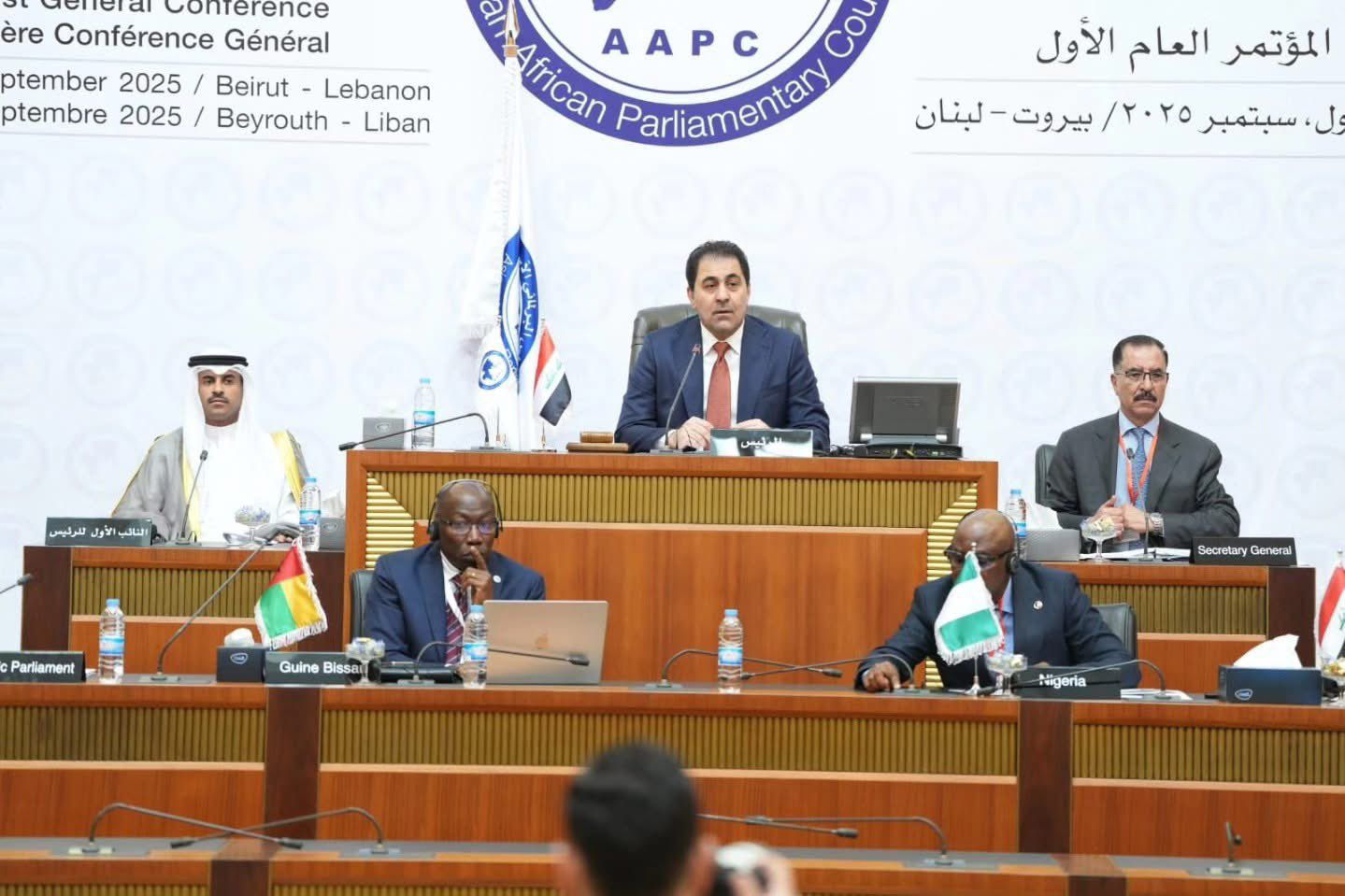
Beirut hosted yesterday the First General Conference of the Asian-African Parliamentary Council, held at the Lebanese Parliament on September 7–8, 2025, in cooperation with the International Federation of Asian and African Trade Unions (IFAATU), and under the patronage of the Speaker of the Lebanese Parliament Nabih Berri, represented by Deputy Speaker Elias Bou Saab.
The conference was attended by:
• The President of the Asian-African Parliamentary Council and First Deputy Speaker of the Iraqi Parliament, Mohsen Al-Mandalawi
• The First Deputy President of the Asian-African Parliamentary Council and President of IFAATU, Saud Rashid Al-Hajilan
• The Speaker of the House of Representatives of Nigeria
• A large number of parliamentary leaders and representatives from Asia and Africa
• Delegations from 37 countries
The conference was chaired by Mohsen Al-Mandalawi, and the Secretary-General of the Council, Fayez Al-Shawabkeh, introduced the speeches.
Elias Bou Saab delivered a speech on behalf of Speaker Nabih Berri, welcoming the heads and deputy heads of parliamentary delegations. He stated:
“The world today is witnessing the formation of a new political model that differs in many ways from the foundations upon which countries were built over the past two centuries. This hybrid model is dominated more by individual economies than collective politics. International politics is no longer the domain of politicians alone—businessmen have entered the political scene, treating politics as a form of profitable enterprise. Even military manufacturing has become more of a business activity than a means of protection and power.”
He continued:
“This new political model demands colored intentions and distorted truths. Hence the importance of your meetings today. Pressure groups worldwide are pushing hidden agendas disguised as noble claims of humanity and justice. But we know the real direction of justice is elsewhere. Therefore, I call on you to form a united front to counter these manipulative lobbies. The issues we face may seem different on the surface, but trust me—the same malicious hands are interfering with all our futures.”
Bou Saab added:
“A wise person today must look to the future with responsive flexibility and reevaluate interests—not principles—especially those based on unwavering core values. Studying the past and learning from it is no longer enough to ensure sound decisions and plan for the future.”
Later, Mohsen Al-Mandalawi, First Deputy Speaker of the Iraqi Parliament, took over the chairmanship of the conference and officially announced the establishment of the Asian-African Parliamentary Council.
In his opening remarks, Al-Mandalawi stated:
“Today, we are laying the foundation for a joint parliamentary council—an effective platform that speaks for the people, defends their causes, and bridges the gap between political decision-making and public aspirations. This is a project for collective revival, based on democracy and capped by human dignity. It is the first step toward political, developmental, and humanitarian progress that will restore the rightful global standing of both continents.”
He emphasized that:
“The world is facing crises: geopolitical conflicts, climate change, economic disparities, food and resource shortages, debt burdens, and the domination of international decision-making under the name of a global order. These challenges highlight the importance of parliaments as bridges between nations, watchdogs over political performance, and supporters of civil society—making the peoples of Asia and Africa a living force capable of action if empowered and unified.”
Al-Mandalawi called for:
• Regular youth and women’s parliamentary conferences to promote political empowerment for future generations
• The launch of a solidarity network in support of just causes, foremost among them the Palestinian cause and the right of its people to establish an independent state with Jerusalem as its capital
He concluded:
“Parliaments must rise to this historic moment to forge a new partnership between Asia and Africa—not based solely on emotion, but on mutual interests and joint efforts to meet challenges, rather than competing over crumbs.”
Saud Al-Hajilan, First Deputy President of the Council and President of IFAATU, then delivered his remarks:
“At the outset, I would like to express my deep thanks and appreciation to His Excellency Speaker Nabih Berri, and to everyone who contributed to organizing and hosting the meetings of the Asian-African Parliamentary Council. We felt the warmth of the welcome and the excellent organization at the historic Lebanese Parliament.”
He added:
“It is truly an honor to be part of this unique parliamentary initiative, under the leadership of a wise and visionary figure like Speaker Berri. Since the foundation of the International Federation of Asian and African Trade Unions (IFAATU), we have worked to make a real and tangible difference in the union movement—enhancing members’ rights, improving union performance, and supporting better work environments. We believe that unionism is not only about defending rights, but is also a pillar of production and development, achieving justice and ensuring duties are fulfilled impartially.”
He continued:
“Today, our Federation brings together millions of workers from both Asia and Africa in a rare example of union unity that has contributed to improving production and its quality. This is just the beginning of a larger ambition, God willing.”
He further stated:
“Managing and advancing societies is a dynamic and ongoing process. It requires constant review and continuous improvement. That’s why the idea of creating a joint parliamentary council between Asia and Africa was born—to serve as an effective link between parliaments and unions, and as a real platform for presenting issues and amplifying the voices of workers and communities directly.”
He concluded:
“As grassroots trade unions, we possess an effective tool to measure the impact and efficiency of legislation in practice, and we offer genuine feedback that can enhance the role of parliaments in shaping policies and making decisions. This synergy between parliamentary and union work represents a historic opportunity to build an integrated system that responds to the aspirations of people in both continents.”
“I am aware that our agenda is full of important topics and discussions, so I will conclude by renewing our hope that this new parliamentary council will achieve its intended goals—contributing to better lives for the people, supporting stability, development, and social justice. We offer your esteemed council all our accumulated experience, confident that joint action is the shortest path to a better future.”